I feel like I have been living in a cave. Believe it or not, I had never heard of Springbrook National Park. It was only after my husband spoke of Springbrook that I asked, “What is this Springbrook of which you speak?’
I have been to the Gold Coast dozens of times, and I have never heard a whisper. How can this be? Best kept secret? Poor marketing? Locals wanting to keep this magical gem all to themselves? The answer eludes me but I am glad that I have rectified this distressful situation; I was seriously missing out!
I can safely say that I am very much in love with Springbrook National Park, it is a truly magical patch of untouched natural beauty.
Located in the Gold Coast hinterland, Springbrook National Park is over 15,000 acres of protected forest – essentially the plateau and mountain range that encompasses Springbrook Mountain and the remainder of the Tweed Volcano. It took me a while to get my head around this. I was looking out over the plains trying to envision how this could be. Where is the volcano? Aren’t they supposed to be big and tall, and well… volcanic in shape? Mt Warning is big and tall, but it didn’t fit my volcano criteria. It was when I did a bit more reading (beneficial sometimes), that I understood that Mt Warning was the volcanic lava plug that endured after the rest of the shield volcano had eroded away – and boy, was there some MAJOR erosion!

The volcano itself would have originally been twice the height of Mt Warning!! What was once the gentle slope, was now an inverted plain – an erosion caldera it’s called. Well, I guess it had 23 million years to erode away, so maybe it is not so impressive now. However, I was on the mark when I said it was ‘major’ – it is the largest erosion caldera in the Southern Hemisphere! Impressive! It is actually quite interesting reading so if you would like to read more, visit: https://en.wikipedia.org/wiki/Tweed_Volcano
The park is actually divided into four different sections – Mount Cougal, Natural Bridge, Springbrook Plateau and Numinbah – and all of the sections are spectacular.
Our visit was a bit of a recognisance mission. Because we (read ‘I’) had never been there before, we (I) just wanted to see the lay of the land. I knew I wanted to climb some of these ‘mounts’ but if you have never been there you don’t really know what you are looking at… and I am somewhat topographically challenged when it comes to maps… I am told.

To be honest, there wasn’t really a lot of information available. All of the information booths were overflowing with literature on all of the theme parks and the other tourist trappings, but slim pickings on Springbrook. No wonder this place is such a secret!
I downloaded and printed a map before I left (just as well), so all good and we set off on our way (the Tourist Information Centre at Springbrook has some better maps and information).

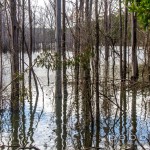
We pretty much drove around the entire Springbrook National Park. We still have a few stops on the eastern area to discover but we did the full circuit on the maps we had. Even driving around is beautiful… the beautiful reflections of the skeletal remains of trees on the still waters of the Hinze Dam, the density of the rainforest as the narrow roads wind their way up to the plateau, the concrete jungle of the Gold Coast a stark contrast against the ocean line, and what I think were masses of little pademelons (rainforest wallabies) – dozens of them *little squeal* – so cute! Actually, I saw more wildlife on this trip than I have on any of my others.

There is so much to see, and we have mapped out a few climbs for next time, so we will definitely be back, but here are some of the stopovers we did on our little adventure:
Natural Bridge
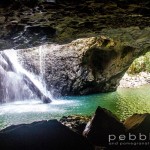
Wow! What an incredible place. The Natural Bridge (also sometimes called Natural Arch) is a waterfall, which was named so because of the ‘natural bridge’ that formed on the watercourse; the water eroding a hole through the rocky basalt overhang and thereby creating a bridge over the rockpool it created in the process.

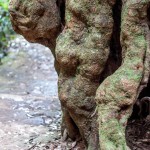
The walk down to the waterfall is just magic. I was on stop/start mode the whole way down to the bridge just in awe at the ancient gnarled trees that lined the paths and the waterway. If only they could talk, the stories they could tell… I am sure they would have a word or two to say about the twits that insist on carving their initials into their stoic massive trunks.

Moss and lichen beautifully shroud rock and tree surfaces creating a tapestry of vivid greenery throughout the forest. Stunning.

The circuit doesn’t take that long to walk, so take your time and breathe it all in. The path opens out into a huge overhang where the water courses through. It is a popular place, so it is fortunate that it is a no swimming zone, which allows you to really appreciate its natural beauty, free of bathers.

Natural Bridge night time visit to see the glowworms
So, you have been to see the Natural Bridge during the day… now go again at night, it is a little bit special.
The cave ceiling is a sparkling solar system of glowworms with their little bums all lit up *little squeal*. We visited in winter so the stellar display is a little more subdued – it was cold, so I totally get it – my lights are out through most of winter, and we were currently in the middle of an ‘arctic vortex’. But even in winter is quite the wonder.
Make sure you take a torch to help navigate your way down to the arch, but make sure you put it out when you get to the arch – the glowworms don’t like the light so you will very promptly snuff them out if you go shining a light about… nothing like ruining it for everyone…
Even at night it is quite a busy place, which is quite comforting when wandering about in the forest, though I still wouldn’t wander around down there by myself. The paths are clear and accessible, so it is a nice easy walk even in darkness. We got there just on dusk, so managed to do the circuit with just enough natural light. A few people took advantage of the picnic tables and brought a picnic dinner so they could linger a little longer…

Best of All Lookout
Another wow! This really is the best of all lookouts. What a view. What an incredible walk to see the view! So lush and green, the paths lined with ancient Antarctic beech trees (said to be over 3,000 years old) and hoop pines, strangler figs gnarling their way around their submissive hosts, moss and lichen lining almost every surface.

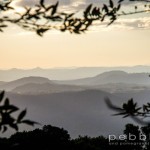
The lookout is on the escarpment – you are literally standing on the border of Queensland and New South Wales looking out into the Tweed Valley – I though that was pretty cool.
From the lookout you get the first real understanding of the volcanic plateau that stretches out before you with Mount Warning the skeletal remains stark and surreal in the centre. It was at this point that I pointed at both Mount Warning and Mount Cougal and said, “I want to climb that one and that one”, so watch this space…

Canyon Lookout
Another beautiful lookout. Slightly different angle and aspect. You can drive right up to this one, so a great one for the physically challenged. Again it is on the edge of the escarpment, and great views along its length. Walking tracks from the lookout of varying distance will take you down to the waterfalls that you can see from the lookout. Leave yourself a bit of time, as the walks, even if you just do the Twin Falls Circuit, are well worth it.

Twin Falls Circuit
Loved this walk. It was another one of those stop/start walks taking dozens of photographs. I wished we had left time to do the 17km Warrie Circuit, but it was our final stop before heading home so we only had time to do the Twin Falls Circuit (4km), which is a smaller offshoot from the larger circuit.

The waterfall spills over the escarpment into a small pool, but the real highlight is walking the paths that lead through rock clefts and under the boulders suspended between these clefts. The moss! The moss is just so iridescently green it pops! And the rusty red of the basalt rockfaces – beautiful. We probably could have walked the 17kms in the time we walked the 4 – I was epically distracted by the splendour of it all.

So many ancient trees, twisted and gnarled. Wow. Incidentally – bit of trivia – some of the brush box trees in this area have been radiocarbon dated back over 1,500 years (double wow), which makes them the oldest carbon dated trees on the Australian mainland – see, it really is wow-worthy!

There are so many other lookouts, walking tracks and places of interest throughout the park, it is impossible to get to them all in one weekend. But we gave it our best effort and we will most certainly be back sometime soon… I have some mountains to climb!
For more information visit:
http://www.nprsr.qld.gov.au/parks/springbrook/about.html

This story was written by Petra Frieser – Pebbles + Pomegranate Seeds